Changelog

Follow new updates and improvements to ESD-alpha.

July 22nd, 2026

Improved Mesh Management and Simulation Assignment Workflow

What's New

This release improves the reliability of mesh management, material assignment, load configuration, and simulation diagnostics. Several workflow enhancements have been introduced to make model setup more intuitive while providing better feedback during simulation.

Improvements

  • Fixed the 2D material assignment workflow by automatically recognizing and assigning materials to the highest-dimensional groups within the imported mesh.

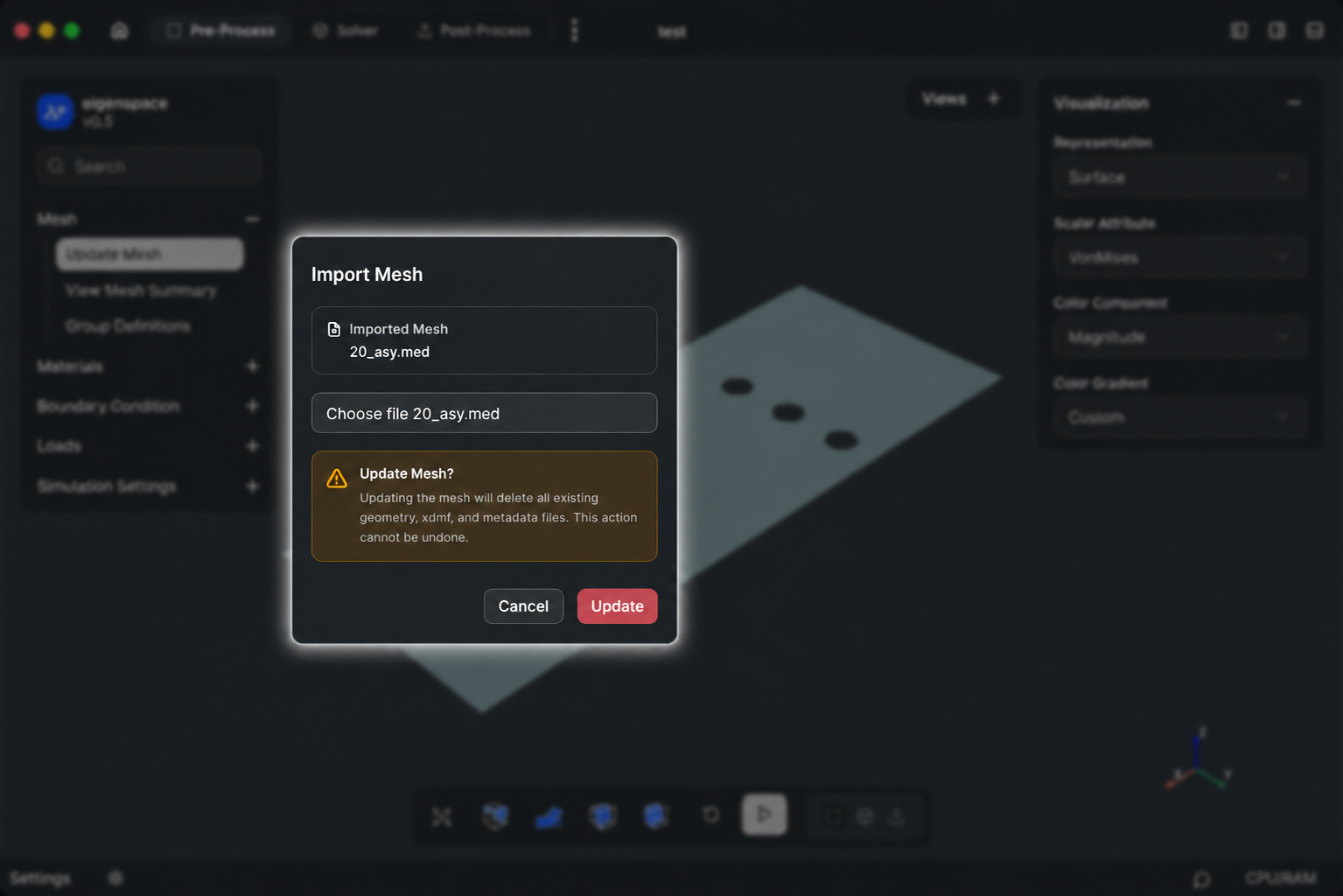
  • Improved mesh import behavior by prompting for confirmation before replacing an existing mesh, ensuring that users are aware that the previous mesh and its associated files will be removed.
  • Enhanced the assignment workflow by automatically expanding the Properties panel when a load or boundary condition is assigned, displaying the appropriate configuration fields based on the selected load or boundary condition type.

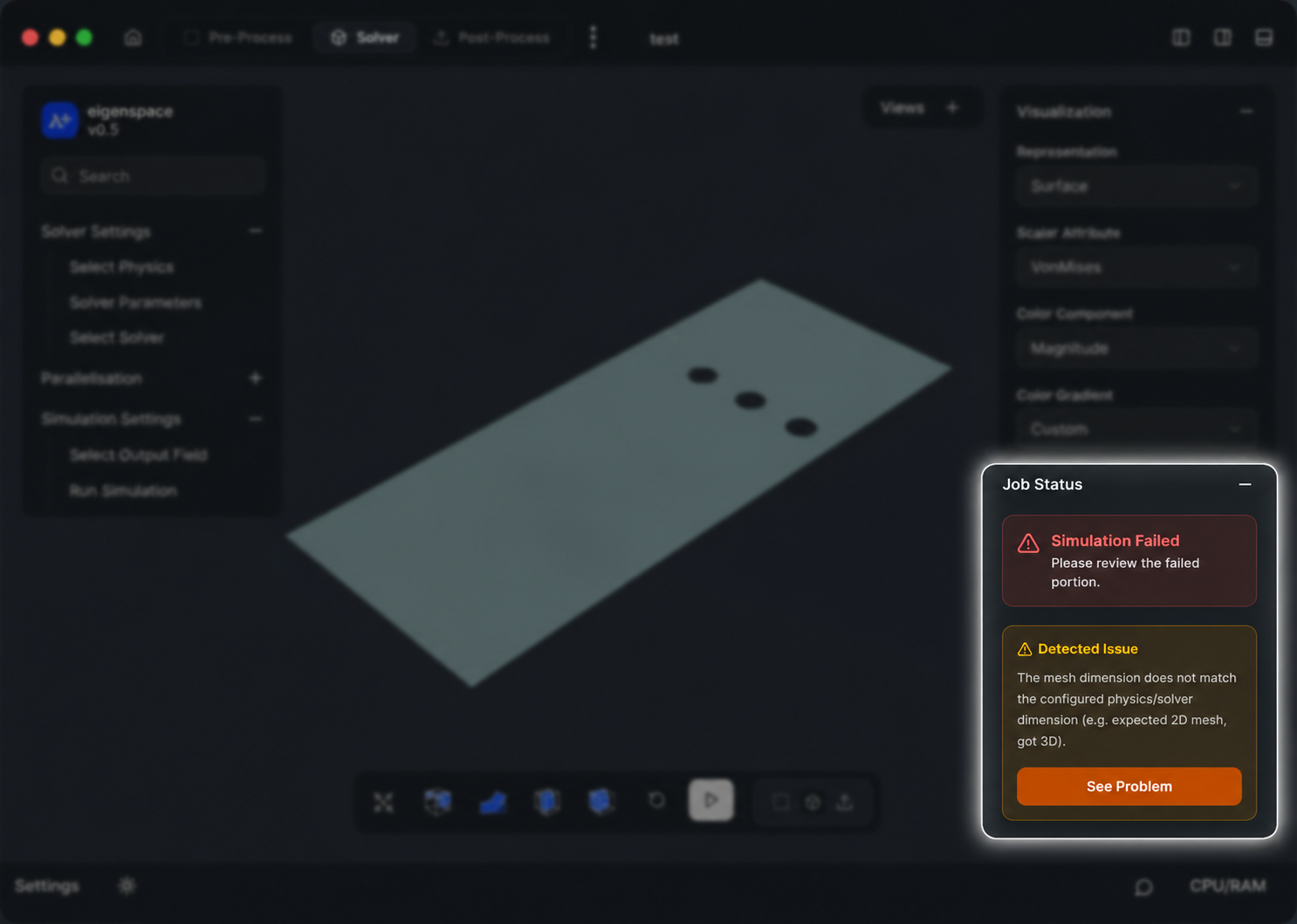
  • Added a Problems button for failed simulation jobs, allowing users to quickly view failure logs and diagnose simulation issues through a dedicated popover.
  • Corrected view orientation and representation for the negative coordinate axes (-X, -Y, and -Z) to provide consistent navigation within the 3D viewport.

  • Improved negative load assignment behavior and added the ability to clear previously assigned load values for easier model editing.

Related Featurebase Request

  • Requested by: Ritesh Barman

Engineering Reference

  • Pull Request: #35

  • Implemented by: Ritesh Barman

July 13th, 2026

Streamlined Simulation Setup and Workflow Improvements

What’s New

The simulation setup workflow has been redesigned to simplify model configuration and improve the overall user experience. Material, boundary condition, and load assignment have been consolidated into a more intuitive workflow, while the interface has been cleaned up and simulation feedback has been made more reliable.

Improvements

  • Simplified the simulation setup by removing the separate Define Material, Define Boundary Condition, and Define Load tabs.

  • Integrated material, boundary condition, and load configuration directly into the Assign Material, Assign Boundary Condition, and Assign Loads workflows.

  • Added a library of predefined materials, boundary conditions, and loads, with the ability to create custom materials, boundary conditions, and loads when required.

  • Improved the right sidebar by removing placeholder statistics, including dummy values for CPU cores, expected simulation time, and RAM usage.

  • Added fallback handling for failed simulation submissions and job execution failures to provide clearer feedback and improve application stability.

  • Implemented by: Ritesh Barman

July 1st, 2026

Productivity and Project Management Improvements

What’s New

This release focuses on improving the overall project management and authentication experience within eigenspacedesign. Several usability issues have been resolved, resulting in a smoother workflow, more reliable authentication, and improved project management capabilities.

Improvements

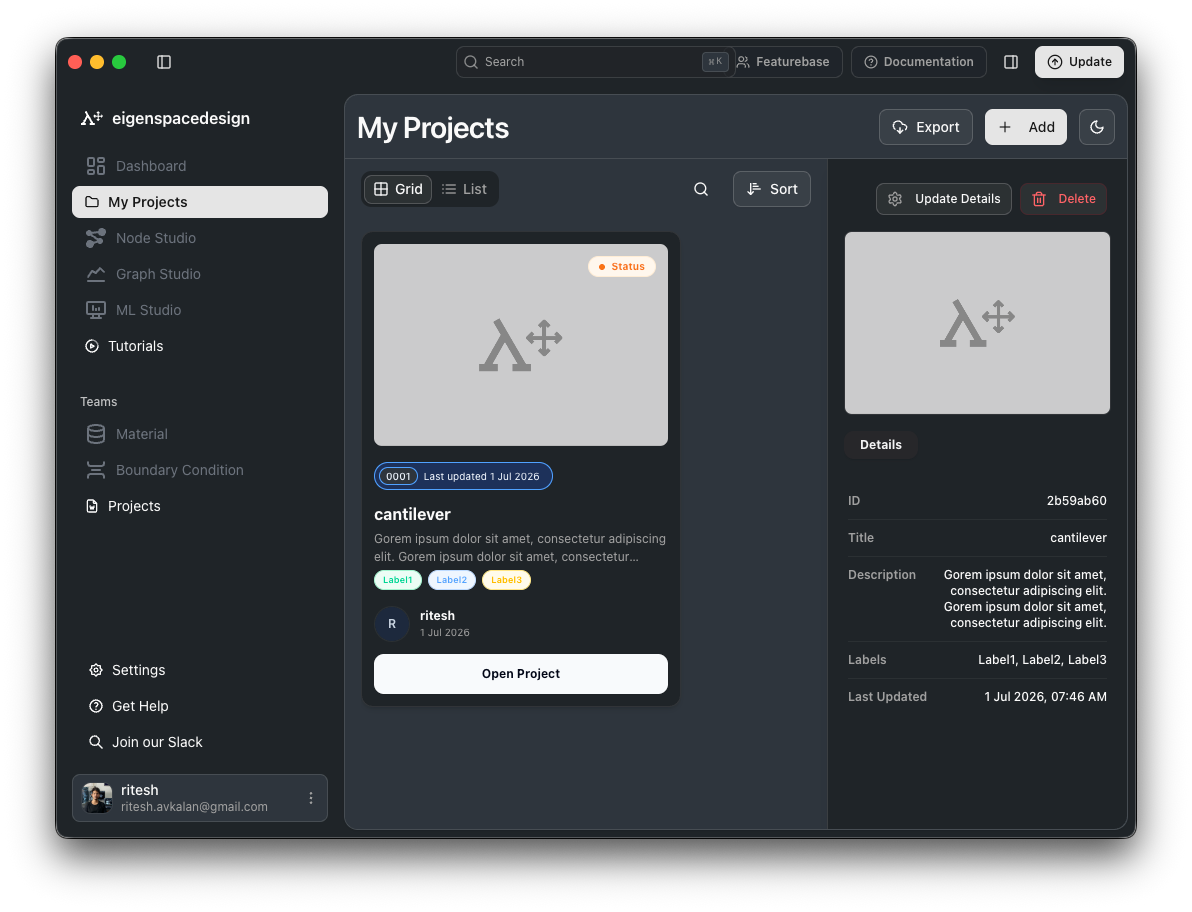
  • Added profile management functionality within the Settings page.

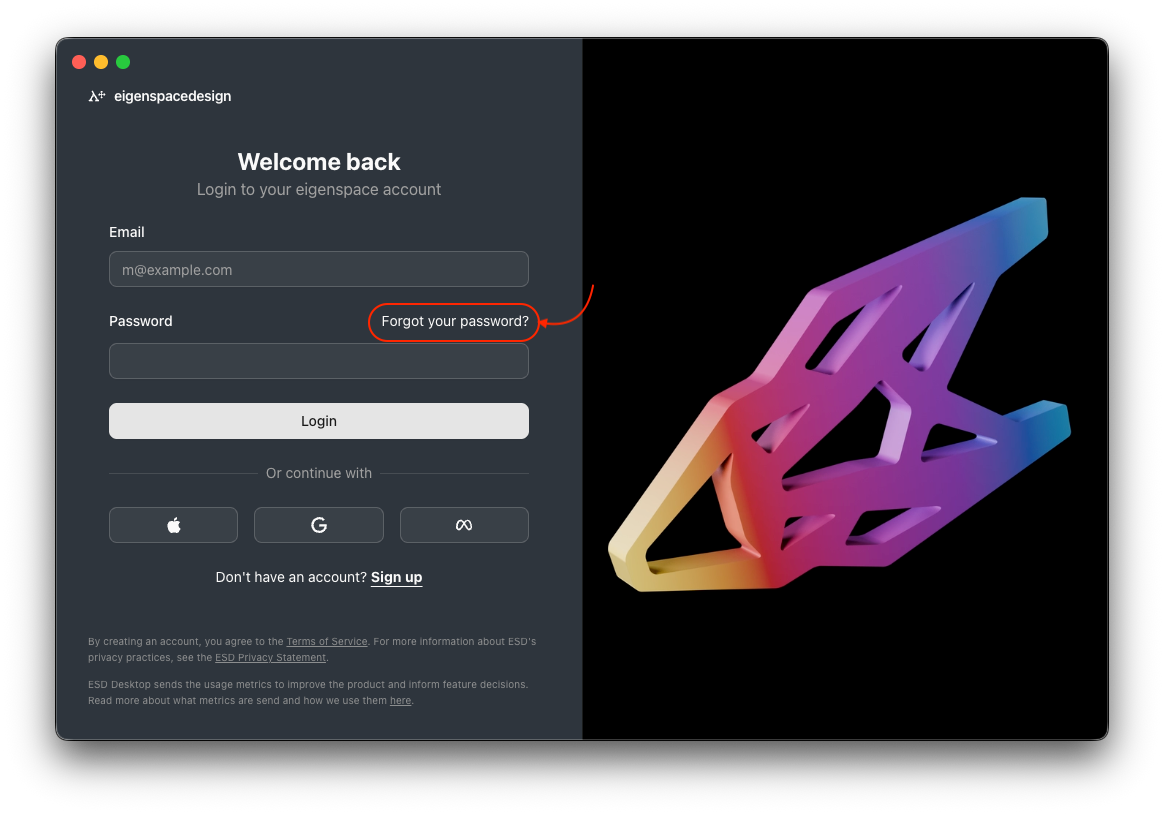
  • Introduced the Forgot Password workflow to simplify account recovery.

    Screenshot 2026-07-01 at 6 23 43 PM
  • Enabled project editing and management capabilities.

  • Fixed project update and delete operations.

    Screenshot 2026-07-01 at 6 30 12 PM
  • Improved sidebar navigation and restored button functionality.

  • Resolved search issues to provide reliable project discovery.

  • Fixed Google Login authentication errors.

  • Updated the application title bar to correctly display the project name and version information.

Bonus Changes

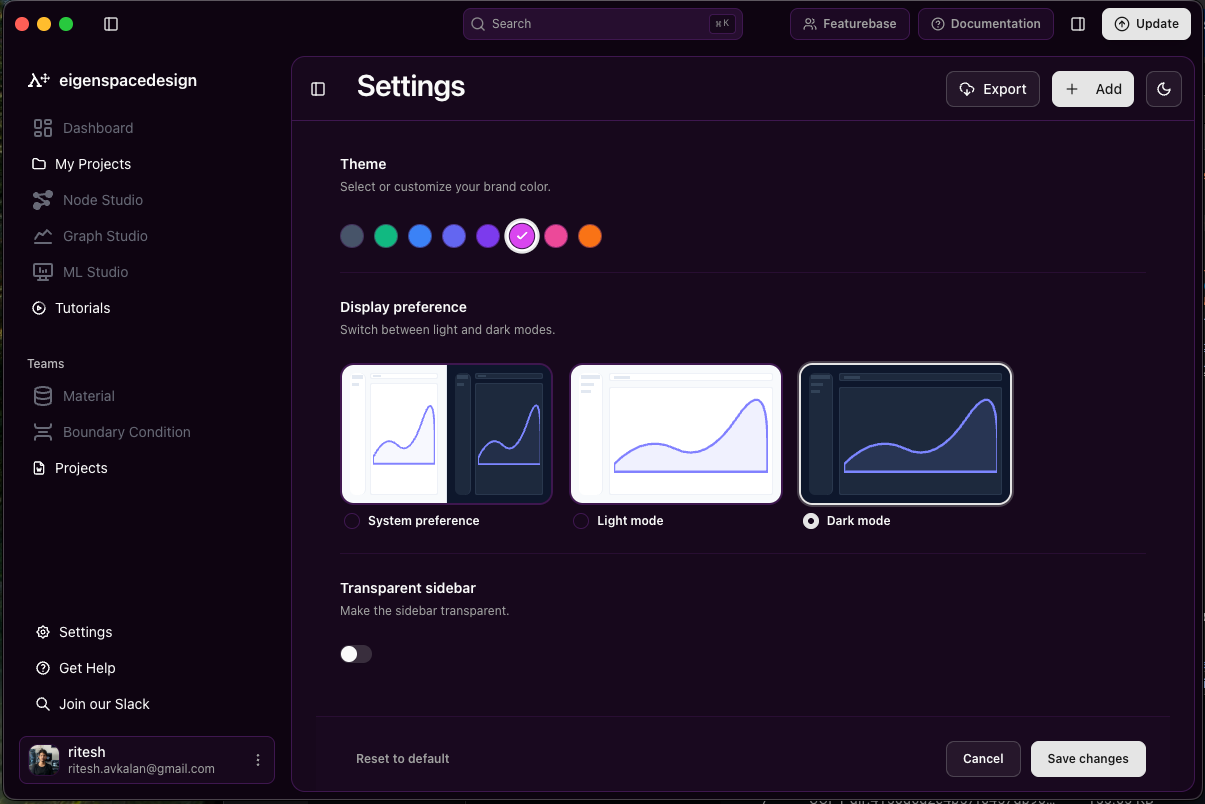
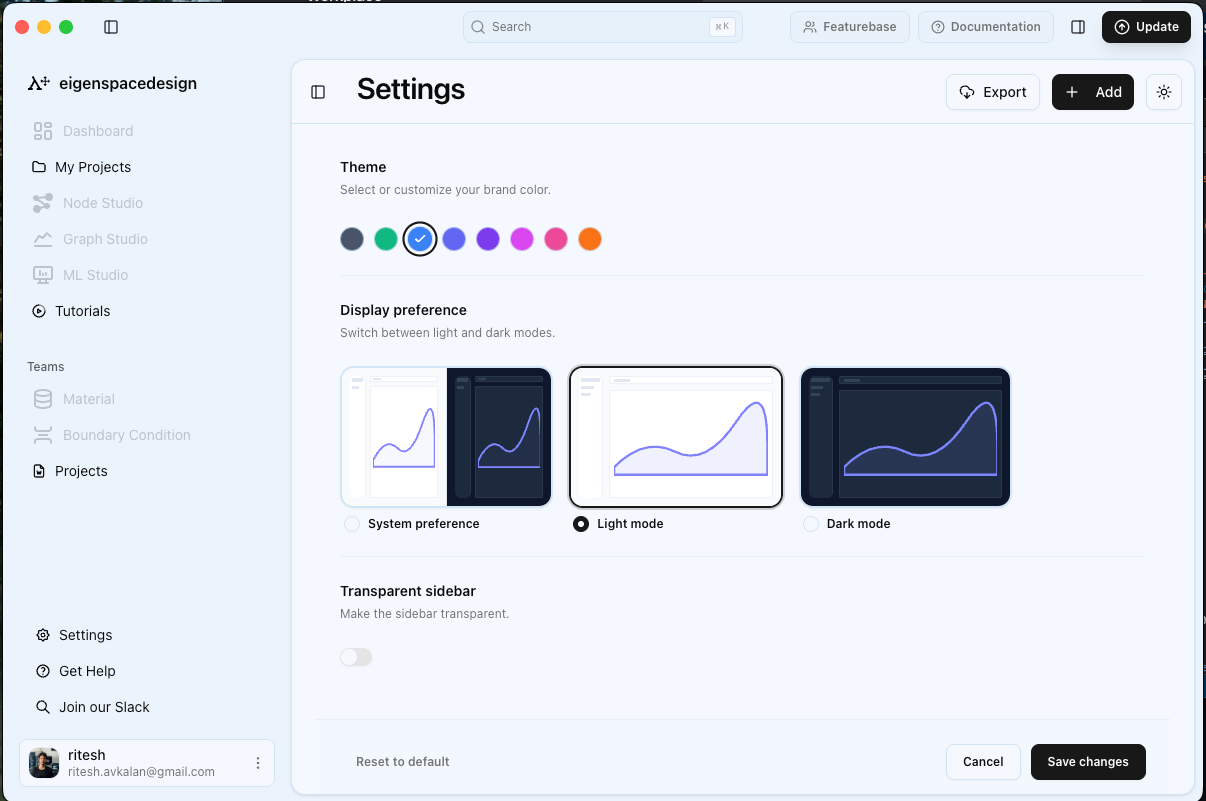
  • Added Five new themes along with dark mode and light mode


Related Featurebase Requests

Engineering Reference

June 29th, 2026

Improved

Fixed

Improved Loading Screen and Login Experience

What’s New

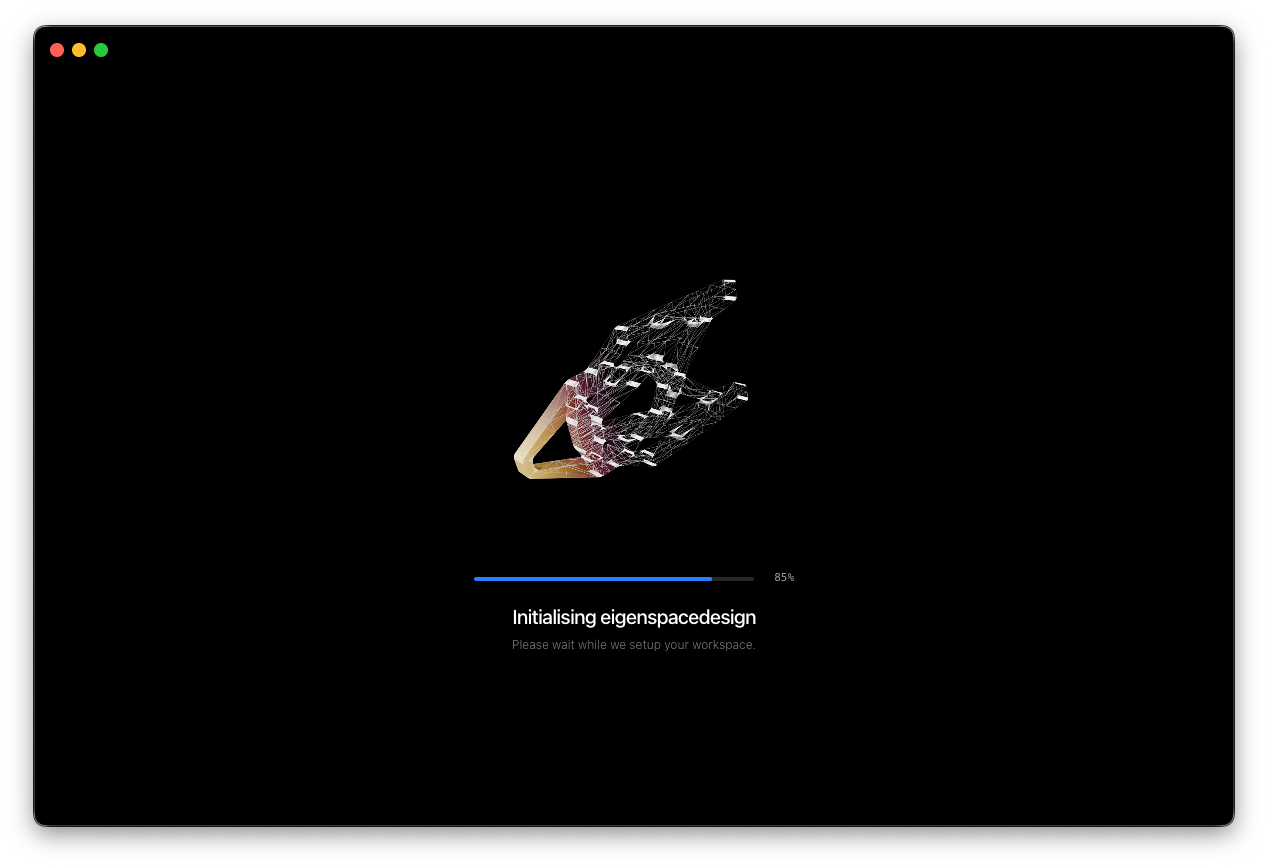
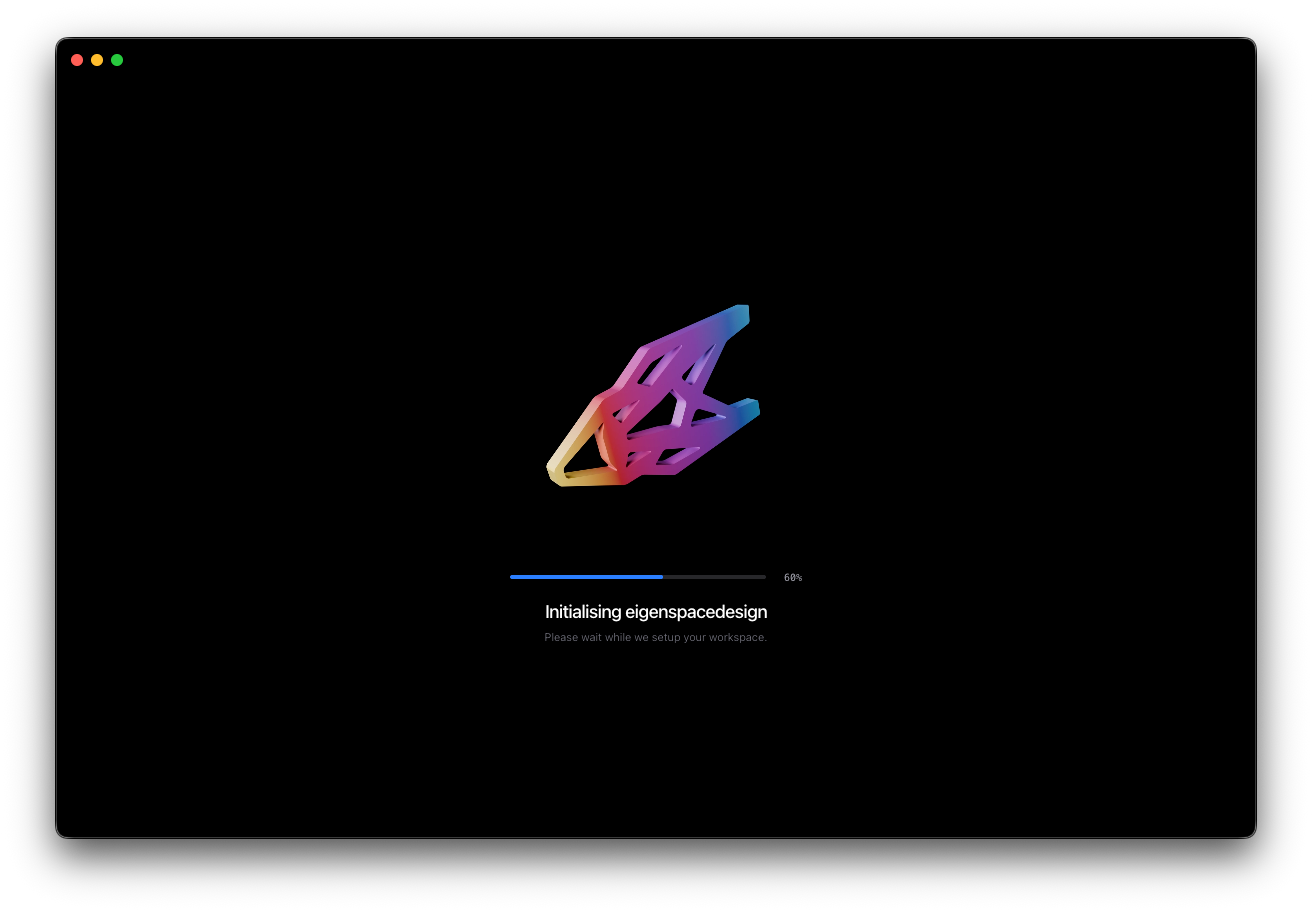
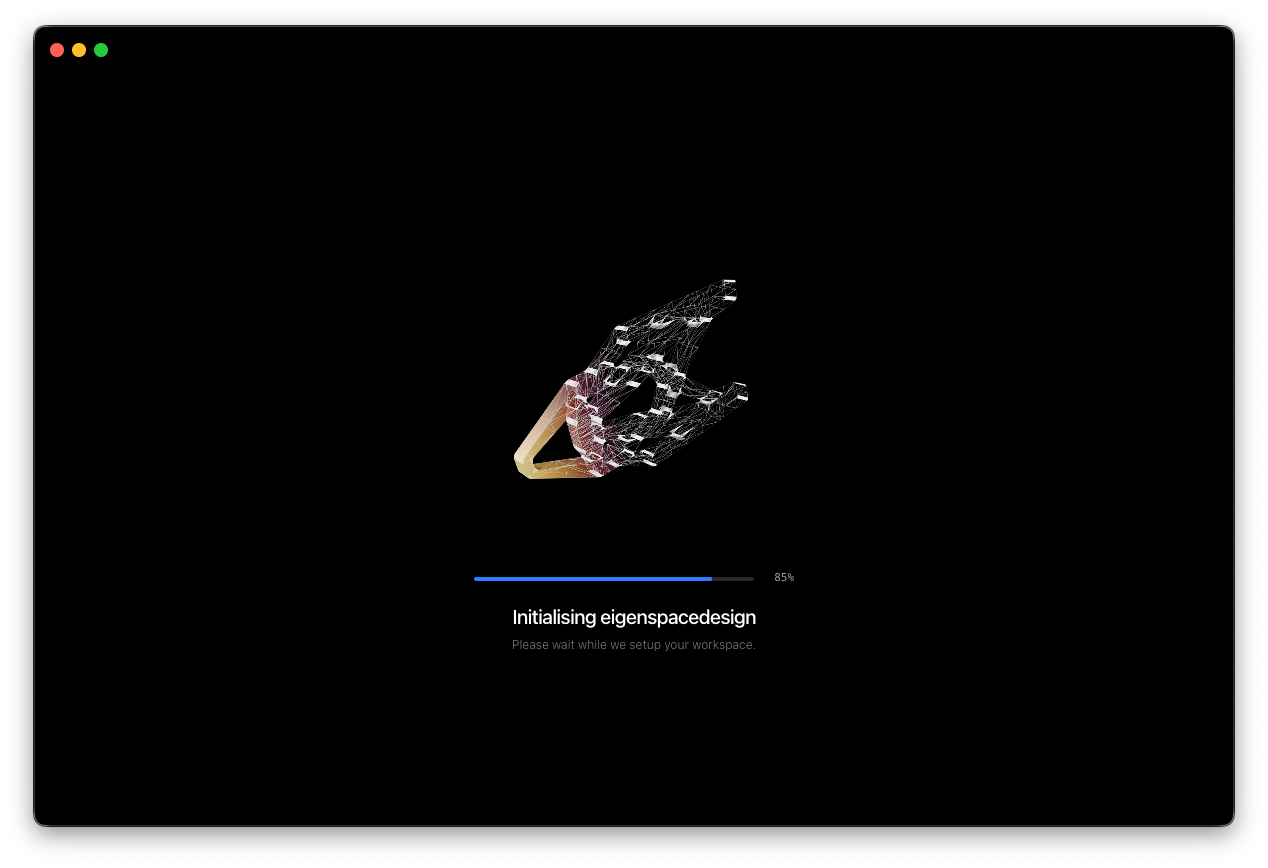
The application startup experience has been redesigned to provide a smoother and more polished onboarding workflow. The loading screen and login interface have been updated to align with the latest design system and deliver a more consistent desktop application experience.

Improvements

  • Redesigned the application initialization screen with an improved visual experience.

  • Finalized the login workflow based on the latest Figma design specifications.

  • Added native desktop window controls (Close, Minimize, and Maximize) to the initialization and login screens.

  • Improved consistency between the loading, authentication, and application interfaces.

  • Enhanced the overall startup flow for a more seamless transition into the application.

Related Featurebase Request

Engineering Reference

June 29th, 2026

Improved

Release date : June 26 , 2026

What’s New

The processing title bar has been redesigned to provide a cleaner interface and quicker access to frequently used actions.

Improvements

  • Removed the legacy processing toolbar.

  • Integrated processing actions into the title bar.

  • Improved viewport alignment.

Related Featurebase Request

Technical References


June 29th, 2026

New

We are excited to introduce eigenspacedesign, a Physics AI simulation platform built to help engineers run, manage, and scale engineering simulations more efficiently.

The first version of eigenspacedesign focuses on creating a complete simulation workflow, starting from mesh import and simulation setup to solver execution and post-processing. The platform is being developed to support modern engineering teams that need faster design exploration, better simulation data management, and AI-assisted physics workflows.

What this release introduces

This initial release lays the foundation for:

  • Mesh import and model setup

  • Load and boundary condition definition

  • Linear static simulation workflow

  • Solver execution inside the platform

  • Basic post-processing and result visualization

  • Simulation data organization for future AI and ML workflows

Why we are building this

Traditional simulation workflows are often fragmented across multiple tools, manual steps, and disconnected data sources. eigenspacedesign aims to bring the complete simulation process into a unified environment where engineers can move from setup to results faster.

Our long-term vision is to turn simulation data into reusable Physics AI models, enabling faster predictions, smarter design decisions, and scalable engineering intelligence.

What comes next

In upcoming updates, we will continue improving the core simulation workflow and add more capabilities for post-processing, parametric studies, automation, collaboration, and AI-driven simulation acceleration.

This is the first step toward building a Physics AI platform for next-generation engineering simulation.